Laser engraving has become an essential technology in craftsmanship, personalised objects, signage and decoration. Precise, fast and clean, it enhances a wide variety of materials with a crisp, durable and elegant finish. In this guide, we explain how laser engraving works, what you can make with it, and why it has become a solution as technical as it is aesthetic — for craftspeople, designers, businesses and individuals looking for personalised, responsible objects.
Laser engraving: a precise and versatile technology
The principle: a concentrated beam of light
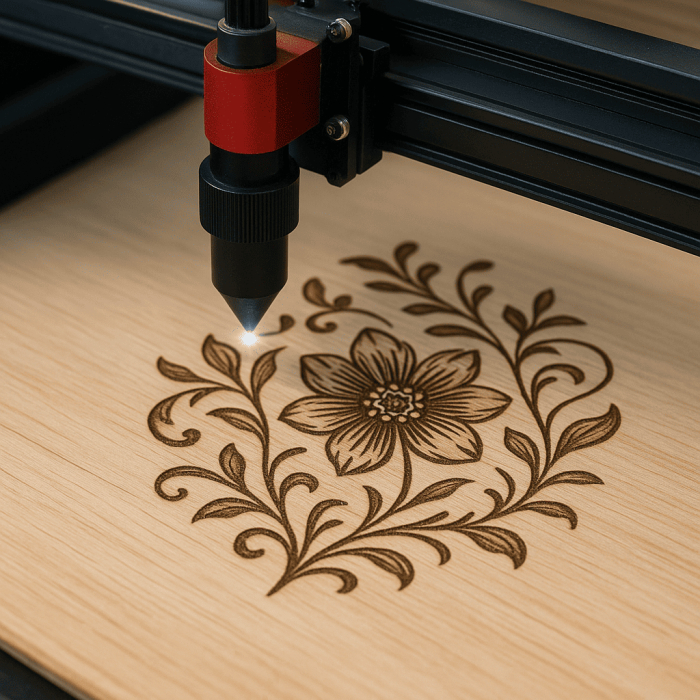
Laser engraving relies on focusing a very powerful beam of light onto a surface. This beam heats the material until it burns, melts or vaporises depending on the material, removing a thin layer with exceptional precision and without physical contact. The result is perfect control over depth, speed and path.
The three technologies: CO2, fibre, diode
- CO2 laser : ideal for wood, acrylic, leather, cardboard or glass; it can also cut.
- Fibre laser : designed for engraving metals (steel, aluminium, stainless steel), perfect for durable objects.
- Diode laser : more compact, for simple surface engravings and small projects.
At 3D Mountain, we work with a CO2 laser, on wood and stainless steel alike, adapting each project to the material, the desired effect and the required durability.
What can you do with laser engraving?
Engraving on metal: elegance and durability
Metal can be laser-marked too, permanently and precisely. In our workshop, we use a CO2 laser to personalise our personalised engraved hip flasks : each hip flask receives a first name, a date or a pattern, for a memorable gift. The engraving won’t fade or rust and withstands water and time — also ideal for promotional items, medals and corporate trophies.
Engraving on wood: natural, warm, expressive
Wood engraves beautifully with a CO2 laser. A living, timeless material, it allows texture, contrast and depth effects that bring out the best in it. A few examples:
- Nose personalised wooden keyrings, both practical and attractive;
- Nose 3D wooden animal trophies, true pieces of wall art;
- Our engraved kitchen items, such as chopping boards.
Laser engraving on wood can also be used to create shop signs, custom signage, birth gifts or wedding menus.
The main advantages of laser engraving
Extreme precision, right down to the details
Logos, text, drawings: even the most complex designs are reproduced accurately, without smudging or damaging the material, on flat and curved surfaces alike.
A permanent finish, with no ink or chemicals
Engraving changes the surface for good: no transfer, no sticker, no fading. A clean, durable and stable solution.
A fast and eco-friendly technique
With no inks, solvents or chemical baths, laser engraving is a dry, economical and environmentally friendly technology. It limits waste and makes the most of natural materials such as wood.
Why choose laser engraving at 3D Mountain?
Based in Bourg-d’Oisans, in the Alps, we design and engrave every piece with passion, on wood or metal. We take care over finishes, patterns and legibility, and we are on hand to advise you, offer mock-ups and adapt the visuals to your wishes. Wall decor, corporate goodies, birth gifts or wedding keepsakes: our engravings combine aesthetics, meaning and local manufacturing. Discover our full range of personalised engraved gifts.
Frequently asked questions about laser engraving
Which materials can be laser-engraved?
The CO2 laser engraves wood, leather, acrylic, glass or cardboard; the fibre laser engraves metals (stainless steel, steel, aluminium). At 3D Mountain, we work with a CO2 laser, mainly on wood and stainless steel.
Does laser engraving fade over time?
No. Engraving alters the material in depth: it doesn’t fade or discolour and is water-resistant, unlike printing or a sticker.
Is laser engraving eco-friendly?
Yes: it’s a dry technique, with no ink or solvent, that limits waste and makes the most of natural materials such as wood.